Abandoned Runways That Have Found a Second Life
When an airport closes, aircraft disappear from its runways, control towers fall silent, and passenger terminals lose their original purpose. Yet the enormous stretches of pavement left behind rarely become useless overnight. Across the world, former airfields have been transformed into public parks, residential neighborhoods, entertainment venues, and cruise terminals. Some preserve their aviation heritage almost entirely, while others erase nearly every trace of the airplanes that once operated there. The future of an abandoned runway often depends less on its physical condition than on its location, surrounding infrastructure, and the needs of the community. What once served as a departure point for travelers can eventually become one of the most valuable public spaces in a city.
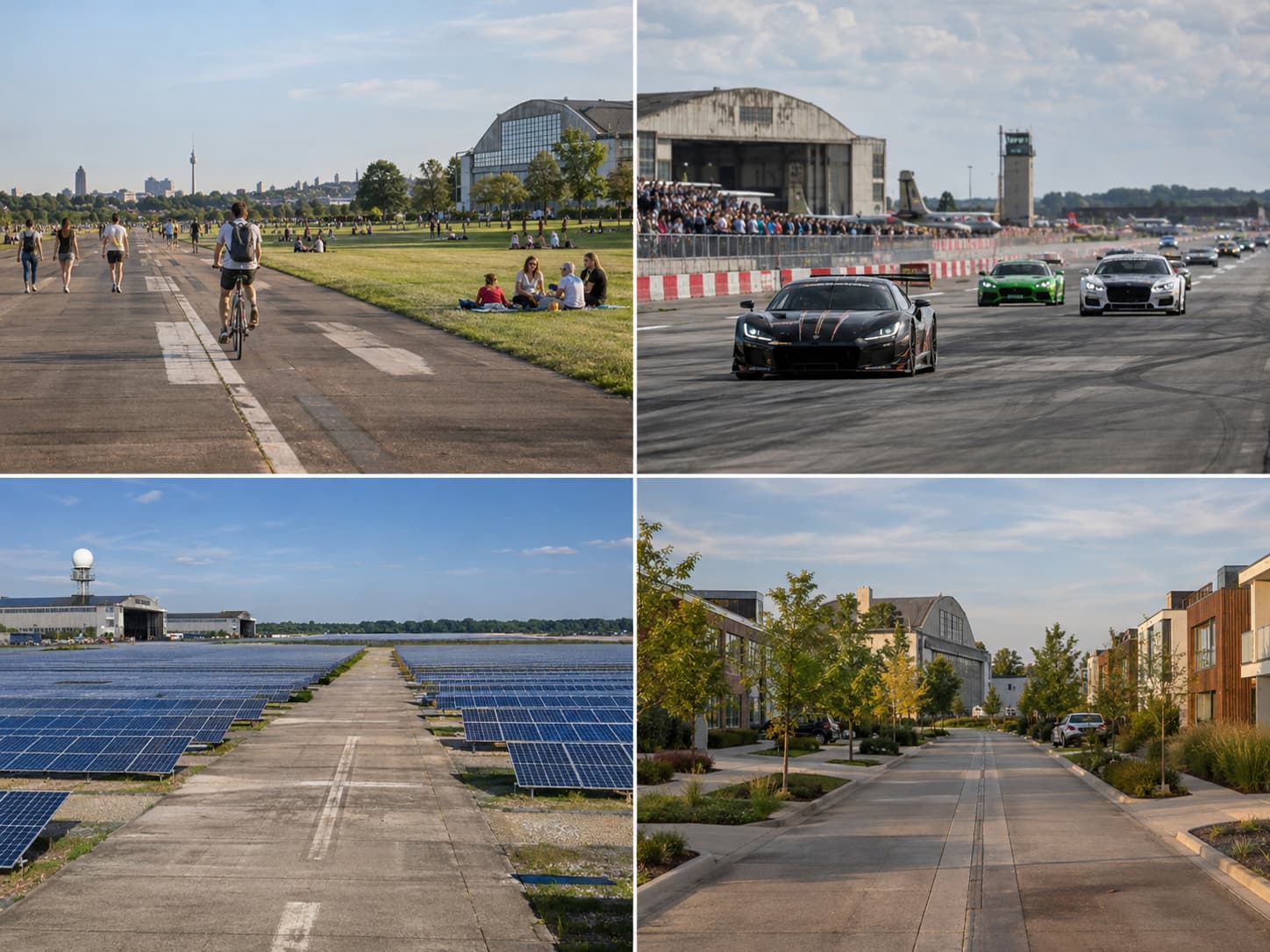
One of the most remarkable transformations can be found in Berlin, where the former Tempelhof Airport has become an extraordinary public space. The airport ceased operations in 2008, leaving behind approximately 300 hectares of open land in the middle of Germany’s capital. Instead of filling the site with buildings, city authorities opened the former airfield to the public in 2010. Today, Tempelhofer Feld attracts cyclists, runners, skateboarders, families, and people simply looking for somewhere to enjoy the outdoors. Its original runways remain accessible, allowing visitors to travel along the same broad paved surfaces where aircraft once accelerated toward takeoff. The surrounding grassland has also become an important urban habitat. In 2014, Berlin residents voted to protect the site from extensive development, demonstrating how strongly the public valued its new identity. Few urban parks offer such an unusual combination of aviation history, recreational freedom, and uninterrupted open space.
In Hong Kong, the former Kai Tak Airport followed a completely different path. For decades, Kai Tak was famous for its dramatic approaches, which brought large passenger aircraft remarkably close to densely populated residential buildings. Pilots navigated a challenging approach before landing on a runway extending into Victoria Harbour. When the new Hong Kong International Airport opened in 1998, Kai Tak’s aviation operations ended. The former runway eventually became part of an ambitious waterfront redevelopment project. At its tip, the Kai Tak Cruise Terminal opened in 2013, allowing enormous passenger ships to dock where commercial aircraft once operated. The terminal can accommodate cruise vessels measuring up to 360 meters in length, while its landscaped rooftop provides panoramic views of the harbor. The site has retained its role as a transportation gateway, but its visitors now arrive by sea instead of air. Its transformation also demonstrates the practical advantages of reusing existing infrastructure. Long, relatively flat airport sites often have valuable transport connections and enough space to accommodate facilities that would be difficult to build elsewhere.
Canada offers another approach through the redevelopment of Edmonton City Centre Airport. Located close to downtown Edmonton, the airport gradually became less practical as commercial aviation shifted toward larger facilities elsewhere. Its final aircraft departed in November 2013, opening the way for a major urban redevelopment project called Blatchford. Unlike Berlin, Edmonton did not preserve its runways as recreational surfaces. Much of the former pavement was removed and recycled to make room for streets, housing, utilities, and green spaces. Blatchford is being developed as a sustainable community designed to eventually accommodate as many as 30,000 residents. Its long-term vision includes renewable energy, reduced environmental impact, pedestrian-friendly streets, and public transportation. The project demonstrates that an airport’s most valuable legacy may be the land itself. Large airfields occupy continuous areas that are difficult to assemble in established cities, creating opportunities to develop entire neighborhoods rather than isolated buildings. However, converting an airport into a residential district requires far more preparation than simply replacing concrete with houses.
The environmental condition of former airfields can significantly influence redevelopment costs. Decades of aircraft operations may leave behind aviation fuel residues, deicing chemicals, and other contaminants. Before construction begins, specialists often need to investigate the soil and groundwater to determine whether treatment is necessary. Old drainage systems, underground utilities, and thick layers of reinforced pavement can create additional engineering challenges. At the same time, existing airport infrastructure may offer considerable advantages. Access roads, electricity connections, drainage networks, and large open areas can reduce the need for entirely new facilities. Developers must evaluate which elements are worth preserving and which should be removed. This balance explains why two airports of similar size can follow completely different paths after closure. A centrally located airfield may become residential property, while a remote site with limited transport connections might be better suited to industrial or recreational activities.
Other former airfields have found less permanent uses. Their enormous paved surfaces make them attractive for motorsport events, driver training, vehicle testing, and film production. Long, straight sections provide controlled environments that are difficult to reproduce on ordinary public roads. Former taxiways and parking aprons can support temporary exhibitions, outdoor festivals, or large gatherings without requiring entirely new infrastructure. However, using a runway for motorsport is not as straightforward as it appears. Airport pavement is engineered primarily to support aircraft loads, while racing vehicles place different demands on surface grip, cornering, and runoff areas. Organizers may need temporary barriers, designated safety zones, additional markings, and surface repairs. A runway that once safely accommodated a heavy aircraft is not automatically suitable for high-speed automobile racing. Nevertheless, these alternative uses can help maintain abandoned facilities while local authorities consider longer-term redevelopment plans.
Renewable energy provides another potential future for closed airfields. Their open terrain, limited tree coverage, and relatively unobstructed exposure to sunlight can make them attractive locations for solar installations. Former airport land may also have electrical connections and access roads that reduce development costs. Solar panels can generate electricity without the extensive construction associated with residential or commercial buildings, making this option particularly interesting for remote airfields with limited demand for other uses. Still, abandoned airports are not automatically ideal solar farms. Developers must consider soil conditions, grid capacity, surrounding land uses, and possible environmental restrictions. Where an airfield remains partially operational, panel placement must also account for aircraft movements and potential glare affecting pilots or air traffic controllers. The most successful conversions depend on matching a new activity to the site’s actual characteristics rather than assuming every unused runway offers the same opportunities.
In the United States, Santa Monica Airport illustrates another dimension of the debate surrounding airfield redevelopment. The city has pursued plans for the airport’s eventual closure and the creation of public open space. Under its agreement with the Federal Aviation Administration, closure is permitted from the end of 2028, although further city action is required. The project highlights the difficult balance between preserving aviation access and responding to residents who want additional parks and recreational facilities. These transformations also raise questions about historical preservation. Former control towers, hangars, runway markings, and terminal buildings can tell stories about aviation development and the communities that depended on air transport. Preserving selected features allows future generations to understand a site’s original purpose without preventing redevelopment. Tempelhof demonstrates how old runways can become treasured public spaces, Kai Tak shows how aviation infrastructure can support maritime tourism, and Edmonton illustrates the opportunity to create an entirely new neighborhood. An abandoned runway might appear to be nothing more than an unusually long stretch of concrete. In reality, it represents decades of investment, a distinctive physical landscape, and an opportunity to rethink how valuable land should be used. Aircraft may never return, but the ground beneath their former flight paths can remain an important part of city life for generations.